
Why do I always need someone to tell me everything is okay?
Do you find yourself repeatedly asking someone if they're mad at you? Rereading text messages to make sure you didn't say something wrong? Asking multiple people for their opinions before making a decision? Maybe you spend hours Googling something just to feel a little more certain that everything is going to be okay.
Even when you get the reassurance you're looking for, that sense of relief doesn't seem to last very long. Before you know it, you're questioning things all over again.
If this sounds familiar, you may be experiencing reassurance-seeking anxiety. While seeking reassurance is a completely normal human behavior, constantly relying on it to manage anxiety can actually keep you stuck in the very cycle you're trying to escape.
What Is Reassurance-Seeking Anxiety?
Reassurance seeking is a behavior that involves looking for external confirmation to reduce feelings of anxiety, doubt, discomfort, or uncertainty.
It's not a diagnosis in itself, but it's a common pattern among people experiencing anxiety, OCD, perfectionism, and relationship insecurity.
When you're struggling with anxiety, your brain may interpret uncertainty as a threat. Getting reassurance from someone else can temporarily make that threat feel smaller.
The problem isn't that you want comfort or support. It's that your brain can become increasingly dependent on reassurance to feel safe, confident, or capable of moving forward.
What Does Reassurance-Seeking Anxiety Look Like?
Reassurance seeking isn't always as obvious as repeatedly asking someone if everything is okay. It can show up in subtle ways throughout your everyday life.
You might find yourself:
Constantly asking your partner if they still love you
Asking people if they're mad at you when their tone changes
Sending screenshots of conversations to friends for their interpretation
Apologizing repeatedly and checking that someone has forgiven you
Asking multiple people for advice before making a decision
Googling symptoms or concerns excessively
Repeatedly checking emails or messages before and after sending them
Needing someone to confirm that you made the right choice
Asking the same question in slightly different ways
Seeking validation that your feelings or reactions are justified
Using social media or AI to repeatedly confirm that something is okay
Struggling to move on from a situation until someone reassures you
Sometimes, reassurance seeking is so ingrained in your daily routine that you don't even realize you're doing it.
Why Do I Constantly Need Reassurance?
Excessive reassurance seeking often has less to do with the actual situation and more to do with how uncomfortable it feels to not know the answer.
There are several reasons you might struggle with this pattern.
Difficulty tolerating uncertainty
Anxiety wants answers. It wants guarantees that nothing bad will happen, that nobody is upset with you, and that you're making the right decisions.
Unfortunately, life rarely offers that level of certainty.
Fear of rejection or abandonment
If you're particularly sensitive to changes in someone's mood, tone, or behavior, reassurance may become a way of checking that your relationships are still secure.
Perfectionism and fear of making mistakes
When you feel pressure to get everything right, making even a small decision can feel overwhelming. Having someone else validate your choice may temporarily relieve that pressure.
Low self-trust
If you've spent years questioning your judgment, second-guessing your feelings, or having your experiences dismissed, you may have learned to rely on other people to tell you what to think or feel.
Past experiences
Growing up around unpredictable reactions, inconsistent relationships, frequent criticism, or emotionally unavailable people can contribute to a heightened need for reassurance.
You may have learned to constantly monitor other people's emotions as a way of protecting yourself.
The Reassurance-Seeking Anxiety Cycle
One of the most frustrating things about reassurance seeking is that it works in the short term.
You feel anxious, you ask for reassurance, and you feel better. Naturally, your brain learns that reassurance is an effective way to manage discomfort.
But over time, this can reinforce the belief that uncertainty is something you can't handle on your own.
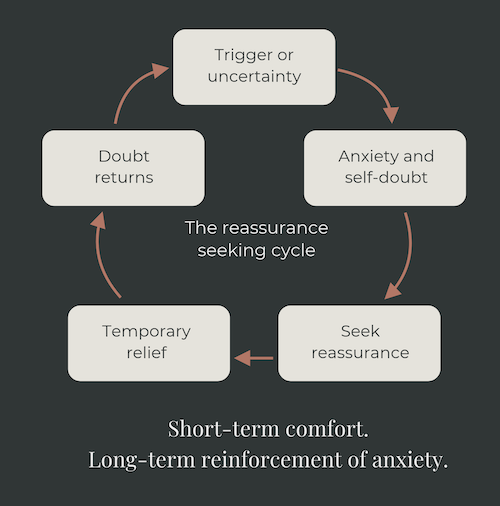
For example, your friend responds to your text with a shorter message than usual. You immediately wonder if you've done something wrong, so you ask if they're upset with you.
They tell you they're just busy. You feel relieved.
But an hour later, you're wondering if they only said that to avoid hurting your feelings.
Now you need reassurance again.
The more you rely on reassurance to resolve uncertainty, the fewer opportunities you have to learn that you can tolerate uncertainty without it.
Healthy Reassurance vs. Excessive Reassurance Seeking
There's absolutely nothing wrong with asking for support, communicating your needs, or wanting to feel secure in your relationships.
The difference often comes down to the purpose, frequency, and impact of the reassurance.
Healthy reassurance might look like:
Seeking emotional connection
Asking for clarification
Considering someone's perspective
Receiving support and moving forward
Feeling comfortable making independent decisions
Communicating a genuine need
Anxiety-driven reassurance seeking might look like:
Seeking absolute certainty
Repeatedly asking the same question
Needing someone to validate your judgment
Experiencing relief followed by more doubt
Feeling unable to decide without approval
Feeling an urgent need to eliminate discomfort
It's also important to recognize that sometimes uncertainty comes from genuinely inconsistent behavior, unclear communication, or unmet needs in a relationship. Not every request for reassurance is a symptom of anxiety.
The goal isn't to become someone who never needs reassurance. It's to develop a healthier relationship with it.
Reassurance Seeking in Relationships
Reassurance-seeking anxiety can be especially noticeable in romantic relationships, friendships, and other close connections.
You might find yourself overanalyzing changes in communication, interpreting someone's need for space as rejection, or assuming that a quiet moment means something is wrong.
You may frequently ask questions like:
“Are you mad at me?”
“Are we okay?”
“Do you still love me?”
“Are you sure I didn't do anything wrong?”
“Promise you're not upset?”
Even when your partner consistently reassures you, your anxiety may continue searching for evidence that something isn't right.
Over time, this can become emotionally exhausting for both you and the people you care about.
Learning to distinguish between a genuine relationship concern and anxiety's desire for certainty can help you build more secure, connected relationships without constantly questioning where you stand.
Is Reassurance Seeking a Sign of Anxiety or OCD?
Reassurance seeking can occur with both anxiety and obsessive-compulsive disorder (OCD).
With anxiety, reassurance seeking often revolves around everyday worries, relationships, decisions, future outcomes, or fears of making mistakes.
With OCD, reassurance seeking can function as a compulsion used to neutralize intrusive thoughts, reduce distress, or obtain certainty about a particular fear.
In both cases, reassurance may provide temporary relief while reinforcing the underlying cycle.
However, reassurance seeking alone doesn't mean you have OCD. Understanding what drives the behavior, how frequently it occurs, and how it impacts your daily life can help determine which therapeutic approach may be most helpful.
How to Stop Constantly Seeking Reassurance
Breaking the reassurance-seeking cycle doesn't mean ignoring your feelings, suppressing your needs, or refusing to ask for help.
It's about gradually learning that you can experience uncertainty without immediately needing to resolve it.
1. Recognize when you're seeking reassurance
Before asking someone a question, take a moment to consider what you're actually looking for.
Am I looking for new information, emotional support, or temporary relief from anxiety?
Building awareness of the behavior is an important first step toward changing it.
2. Practice delaying the urge
Instead of immediately asking for reassurance, try waiting five or ten minutes.
Notice what happens to your anxiety during that time. You may discover that the intensity of the feeling changes even without receiving an answer.
Gradually, you can practice allowing more space between experiencing anxiety and responding to it.
3. Learn to sit with uncertainty
Rather than trying to convince yourself that everything is definitely okay, practice accepting that you may not know for sure.
Try reminding yourself:
I don't need to have every answer right now.
Feeling uncertain doesn't automatically mean something is wrong.
I can handle discomfort without immediately fixing it.
I can make a decision without knowing exactly how it will turn out.
I can trust myself to navigate whatever happens next.
The goal isn't to replace external reassurance with endless internal reassurance. It's to become more comfortable with not having complete certainty.
4. Build trust in your own judgment
Start making small, low-stakes decisions without asking someone else to weigh in.
Choose what to wear, send a text without having someone proofread it, or make a purchase without asking multiple people for their opinions.
Self-trust develops through experience, not through waiting until you feel completely confident.
5. Ask for support instead of certainty
You can still lean on the people you love without asking them to eliminate your anxiety.
Instead of asking, “Are you sure everything is going to be okay?” try saying, “I'm feeling really anxious right now, and I could use some company while I work through it.”
You deserve support, even when there isn't a definitive answer to your worries.
How Therapy Can Help With Reassurance-Seeking Anxiety
When reassurance seeking becomes a regular part of how you manage anxiety, simply telling yourself to stop isn't always enough.
Therapy can help you understand what's driving your need for reassurance and develop practical ways to respond differently.
In therapy, we can work together to:
Identify your reassurance-seeking patterns and triggers
Understand the underlying fears contributing to your anxiety
Develop a greater tolerance for uncertainty
Reduce overthinking and excessive checking behaviors
Build confidence in your own decisions and judgment
Navigate relationship anxiety and communicate your needs
Develop healthier ways to regulate your emotions
Strengthen your sense of self-trust
Depending on your individual needs, therapeutic approaches such as Cognitive Behavioral Therapy (CBT), Acceptance and Commitment Therapy (ACT), and, when appropriate, Exposure and Response Prevention (ERP) can help address the patterns that maintain anxiety and compulsive reassurance seeking.
You Don't Have to Feel Certain to Feel Okay
Imagine being able to send a text without analyzing it afterward. Make a decision without asking five different people what they think. Notice a change in someone's mood without immediately assuming you've done something wrong.
That's not about becoming indifferent or caring less. It's about learning to trust yourself enough that you don't need constant confirmation from the world around you.
At Mood and Mind Counseling, I help adults, young adults, and teens navigate anxiety, overthinking, perfectionism, people pleasing, relationship challenges, and the patterns that leave them feeling mentally exhausted.
I offer in-person therapy in South Pasadena and the greater St. Petersburg, Florida area, as well as online therapy throughout Florida.
If you're ready to spend less time second-guessing yourself and more time actually living your life, I invite you to schedule a free 15-minute consultation to see if working together might be a good fit.
Frequently Asked Questions About Reassurance-Seeking Anxiety
-
Yes. Excessive reassurance seeking is a common anxiety-related behavior, particularly when someone struggles with uncertainty, overthinking, fear of rejection, or self-doubt.
-
Reassurance can temporarily reduce anxiety while reinforcing the belief that you need external confirmation to feel safe. Over time, this can increase your reliance on reassurance.
-
Yes. Reassurance seeking can occur with generalized anxiety, relationship anxiety, perfectionism, and other emotional challenges without someone having OCD.
-
Start by identifying your triggers, gradually delaying the urge to ask, practicing tolerance of uncertainty, and communicating your emotional needs without always requesting confirmation.
-
Yes. Therapy can help you understand the underlying causes of reassurance seeking, interrupt anxiety-driven behaviors, build self-trust, and develop healthier coping strategies.